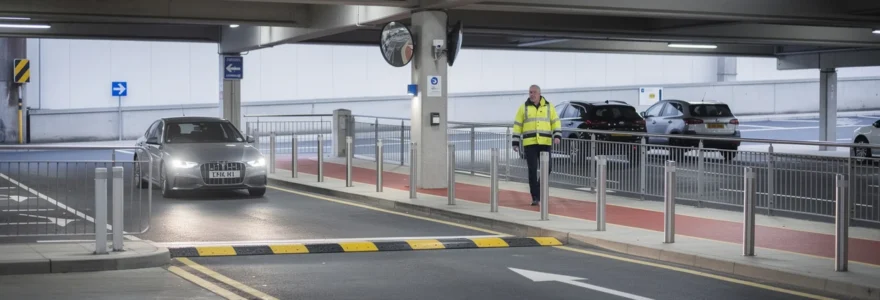
Under the Health and Safety at Work Act, every car park owner and operator has a duty to ensure their site is safe for both vehicles and pedestrians. Meeting this responsibility means looking beyond a single product and instead building a layered system of protection, covering vehicle segregation, clear signage, adequate lighting, fire precautions, controlled access, and ongoing structural maintenance. Whether you manage a small surface-level car park or a multi-storey facility, the right combination of equipment reduces the risk of collisions, slips, and unauthorised access while keeping the site functional day to day. This guide sets out the essential measures to consider across each of these areas, helping you identify gaps in your current setup and plan improvements with confidence.
Vehicle segregation systems and pedestrian walkway design
Separating vehicles from pedestrians is one of the most effective ways to reduce accidents in a car park. This involves a combination of physical barriers, clearly marked routes, and traffic-calming measures that work together to control how vehicles move and where people walk.
Anti-slip flooring solutions for ramps and corridors
Slip-resistant walkways are a basic requirement for pedestrian safety, particularly on ramps, in corridors, and at entrances where surfaces may become wet or greasy. Maintaining these surfaces properly, alongside clear route markings, helps ensure pedestrians are guided safely away from vehicle paths and reduces the likelihood of falls.
Bollards, guardrails and crash barriers to BS EN 1317 standards
Bollards, guardrails, and crash barriers each play a distinct role in protecting people and infrastructure. Pedestrian guardrails are particularly useful where visibility and safety are critical, clearly marking the walkways that pedestrians should follow. Bollards can be used to warn drivers and pedestrians alike, drawing attention to hazards or vulnerable areas, and are available in fixed, removable, retractable, and automatic formats to suit different levels of access control.
For higher-risk locations, such as factories or delivery areas where vehicles move slowly but frequently, Armco barriers provide a substantial, highly visible barrier between traffic and pedestrians, also helping to prevent costly damage to buildings. Choosing the right type of barrier depends on the volume and speed of traffic, as well as the level of protection required for the people and structures nearby.
Convex mirrors for blind spot elimination at junctions
Blind spots at junctions, corners, and tight turns within car parks can significantly increase the risk of collisions between vehicles or between vehicles and pedestrians. Positioning convex mirrors at these points allows drivers to see around obstructions before committing to a manoeuvre, complementing other traffic management measures already in place.
Speed bumps and speed cushions: TRL specifications
Restricting vehicle speed is a core part of traffic management in any car park. A speed limit should be set, ideally 15 mph or below, and clearly signposted. However, signage alone rarely guarantees compliance, so speed bumps are commonly used to reinforce the limit and give operators more control over the flow of traffic.
Speed bumps are typically available in two heights: 50mm for situations where speed must be restricted to 15 mph, and 75mm for stricter control down to 5–10 mph. They should be clearly marked for visibility and supplied with the caps and fixings needed for secure installation. Positioning matters just as much as height: vehicles should ideally cross speed bumps in a straight line, since turning on them can damage both the bump and the vehicle, as well as cause discomfort for occupants. Bumps should also be set back from junctions to reduce the risk of vehicles stalling as they pull away.
Speed ramps offer a similar function and are often manufactured from recycled thermoplastic, making them an eco-friendly option that softens impact on contact. Many are fully customisable, with separate middle and end sections available so the ramp can be fitted precisely to the width of the road or lane.
Signage and wayfinding compliance under UK regulations
Clear signage is essential for guiding drivers and pedestrians safely through a car park, and it works hand in hand with physical infrastructure such as speed bumps, barriers, and flow plates.
Mandatory signage per the traffic signs regulations and general directions (TSRGD) 2016
Speed limits, one-way systems, and other traffic rules within a car park should always be clearly signposted so drivers are given fair warning of what to expect. This is particularly important around features such as flow plates, which only allow traffic to move in one direction; signage should accompany these installations so drivers understand the restriction before they encounter it.
Height restriction bars and clearance signage for Multi-Storey facilities
Height restriction barriers are a practical way to deter larger vehicles from entering car parks with limited clearance, such as low-level sites or multi-storey structures, or where spaces are reserved for staff only. These barriers are generally quick and easy to install, and nudge bars can be added to adjust the acceptable height according to specific site needs. They are commonly available in 2000mm, 4000mm, and 6000mm options, allowing operators to choose the clearance that matches the vehicles they want to restrict.
To reinforce these physical restrictions, permanent obstacles such as barrier hoops can be installed to secure a wider perimeter, ensuring vehicles only attempt entry at the designated point. These also help indicate where parking spaces end and where the pedestrian area begins, and can be used to protect vulnerable entrances and exits to a building.
Photoluminescent emergency exit markings to BS 5266
In enclosed or multi-storey car parks, clear and visible emergency exit routes are essential, particularly in areas where natural light is limited. Well-placed, durable exit markings help ensure that pedestrians can find their way out quickly and safely if needed, complementing the site’s wider evacuation planning.
Lighting and visibility infrastructure
Good visibility is fundamental to safety in any car park, affecting everything from a driver’s ability to see pedestrians to the effectiveness of security monitoring.
LED illumination levels per BS EN 12464-2
Adequate lighting throughout a car park, particularly in enclosed or multi-storey structures, helps drivers and pedestrians see hazards, signage, and each other clearly. Consistent illumination across walkways, vehicle routes, and stairwells reduces the risk of accidents and supports the effectiveness of other safety measures such as guardrails and bollards.
CCTV integration with ANPR (automatic number plate recognition)
Monitoring systems, including CCTV linked with automatic number plate recognition, support both security and traffic management. They allow operators to track vehicle movement, identify unauthorised access, and review how effectively existing safety measures, such as barriers and flow plates, are being used. This kind of ongoing monitoring can highlight where adjustments are needed, for example if speed bumps or flow plates need repositioning, or if pedestrians are still venturing into unsafe areas.
Motion-activated lighting for stairwells and underground bays
Stairwells and underground or lower-level bays often require additional lighting attention, since these areas can be poorly lit by natural light and are frequently used by pedestrians moving between parking levels and building entrances. Reliable lighting in these zones supports safer pedestrian movement and helps maintain visibility around fixed safety equipment such as handrails and signage.
Fire safety and emergency response equipment
Fire safety is an integral part of car park design and management, particularly in enclosed or multi-storey structures where smoke and heat can build up more readily than in open-air sites.
Fire extinguisher placement according to BS 5306
Fire extinguishers should be positioned at appropriate intervals throughout the car park, particularly near likely fire risk points, and kept clearly visible and accessible at all times. Regular checks should form part of the site’s broader maintenance routine.
Sprinkler systems and smoke ventilation in enclosed car parks
Enclosed car parks benefit from fire suppression and smoke ventilation systems that help contain fires and clear smoke, protecting both the structure and the people using it. These systems work alongside other safety equipment to reduce risk in spaces where natural airflow is limited.
Emergency assembly points and evacuation route planning
Clear evacuation routes and designated assembly points ensure that, in the event of a fire or other emergency, pedestrians and drivers can leave the car park quickly and safely. These routes should be planned with the same care given to everyday pedestrian walkways, taking into account barriers, signage, and lighting along the way.
Access control and barrier systems
Controlling who and what enters a car park is central to both security and safety, and there are several types of barrier systems suited to different levels of traffic and site requirements.
Automatic number plate recognition (ANPR) barrier integration
Automatic raise arm barriers provide a secure and efficient way to manage vehicle access in high-traffic or security-sensitive areas. Operated via automated systems and remote controls, they improve convenience, support smoother traffic flow, and offer stronger security through programmable access control. Their durability makes them well suited to locations requiring reliable, long-term access management, and they can be integrated with number plate recognition systems to automate entry and exit further.
Rising arm barriers versus Bollard-Based access control
Manual raise arm barriers offer a cost-effective and dependable alternative, particularly for low-traffic areas or sites where a power supply is limited or unavailable. They are simple to operate and maintain, commonly used in public and private car parks that require access control during specific periods, such as overnight closures. Manufactured from durable materials and often lockable in both open and closed positions, manual barriers provide a straightforward method of access restriction.
Bollards offer a different approach to access control. Fixed bollards create a permanent restriction, while removable, retractable, and automatic versions allow for more flexible management of vehicle access, such as permitting deliveries at set times while otherwise keeping an area pedestrian-only. The choice between rising arm barriers and bollards often comes down to how frequently access needs to change and how much traffic the site handles.
Pay-and-display machines and contactless payment terminals
Payment infrastructure, including pay-and-display machines, should be protected from accidental vehicle impact, particularly in car parks with heavier traffic. Hooped barriers are useful here, as they safeguard infrastructure such as payment machines, lighting columns, and walls from collision damage, while also helping to define traffic routes around these fixed points.
Structural maintenance and risk assessment protocols
Even the best safety equipment depends on a well-maintained structure. Regular inspection and repair work ensures that the car park itself remains safe to use, and that installed safety measures continue to function as intended.
Concrete spalling inspection and repair under BS 8110
Multi-storey and enclosed car parks are particularly susceptible to structural wear over time, including concrete spalling caused by water ingress and reinforcement corrosion. Regular structural inspections help identify these issues early, allowing repairs to be carried out before they compromise the safety of the building or the equipment fixed to it.
Drainage systems to prevent ice formation and standing water
Effective drainage is essential for preventing standing water, which can freeze in colder months and create slip hazards for pedestrians and traction issues for vehicles. Grit bins and storage bins provide a convenient way to store salt or grit on site, ensuring it is readily available when frost or icy conditions occur. Alongside good drainage, this helps maintain safe surfaces across walkways and vehicle routes throughout the year.
Regular compliance audits against the health and safety at work act 1974
Ongoing compliance checks help ensure that a car park continues to meet its obligations under the Health and Safety at Work Act. This includes regularly checking the security of fixings on installed equipment, such as speed bumps, barriers, and bollards, to confirm they remain safe and functional. Monitoring how these measures are actually used in practice, for example whether pedestrians are still crossing through traffic routes, can highlight where additional guidance or equipment is needed.
Litter bins also play a small but useful part in day-to-day site safety, helping keep car parks clean and reducing the risk of punctured tyres or injuries caused by discarded debris. Similarly, steel knee rails can help define boundaries within the car park, controlling traffic flow and protecting pedestrians while keeping the layout clear and unobtrusive. Together with cycle stands, which declutter walkways and provide secure, designated bicycle parking, these smaller elements of street furniture contribute to a car park that is not only compliant but genuinely pleasant and safe to use.